Ever since last spring’s class when we devoted a great deal
of time to the subject, I’ve been fascinated by the uprisings on June 17th,
1953 in East Germany to the oppression of socialism. Berlin as a divided city
is a subject I’m certain many of my peers will choose to explore, but this
event in particular is one most interesting to me. Although the movements
themselves originated outside the city, the culmination of the movement occurred
in Berlin, where thousands marched against soldiers and tanks. Many more were
arrested and either sentenced to death or Siberian concentration camps. West
Berliners met many of the protesters as they made their way through West
Berlin, and the event was widely covered and supported in West Germany. What
was surprising as I learned about this movement, along with its causes and
consequences, was how I had never even heard of it before we covered it in
class. Considering how well known the Berlin Wall is in modern culture, it’s
amazing that Americans aren’t more familiar with this uprising. A popular
resistance against an oppressive regime should ring all too familiar for those
of us even just casually versed in American history, but unfortunately the
events of that June day remain yet another nearly forgotten historical event
for many of us. I would hypothesize that fewer people than ideal are familiar
with the movement because it wasn’t responsible for the downfall of socialism
in East Germany. Often times, our cut and dry culture of wins and losses views
history too stringently and doesn’t consider greater significance when
observing a historical event. Maybe if more people understood the stakes of the
resistance and what it meant for both East Germans and the SPD (the ruling
party of East Germany) at the time, they would have a greater appreciation for
the event. I’m already looking forward to visiting the spot in Berlin where
thousands of people marched in support of freedom despite the danger and
certain
consequences.
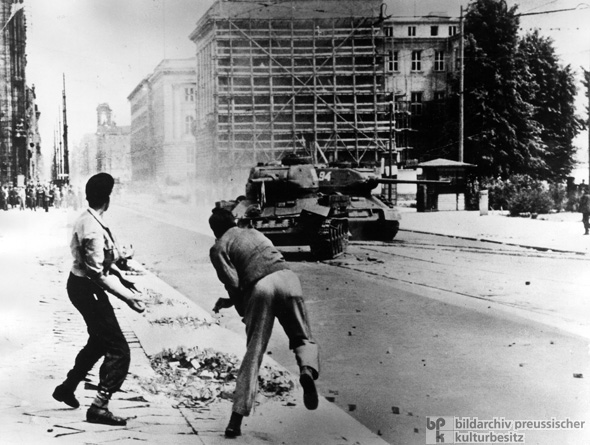
Protesters on June 17th attempt to take on a Russian tank.

East Germans march into Berlin.
Another
topic that interests me about Berlin was its role at the end of World War II.
This was yet another topic covered in a class last year that I wasn’t terribly
familiar with. When the army invaded the city during the last days of the wars,
the citizens of Berlin experienced an absolutely heinous fate. Thousands upon
thousands of women were raped by Russian soldiers as the entire city struggle
to stay alive in the face of hunger and despair. The destruction of both the
physical city of Berlin, along with the physical and emotion damage done to its
people, mirrored what the war had done to Germany as a country. For many
Berliners, it seemed impossible that things had turned so bad after all the
promise and prosperity of the past decade. They had only just recently begun to
feel proud as a people again, only to suffer both a figurative and literal destruction
of their country, ideals, and identity. In Berlin, this devastation was particularly
amplified, with the enemy within the gates and omnipresent in the city. I could
not believe the staggering amount of rape and abuse that occurred in just a few
weeks—especially considering the “good guys” were the perpetrators. It
certainly brings up a number of interesting questions. For example, just
because we call ourselves the good guys, does that make it true? From a very
early age we’re taught that our country and our allies are the noble and “good”
countries of the world, while our enemies are inherently “bad”. I think people
who lived in Berlin in April, 1945 might have something to say about that.

Red Army soldiers place a Soviet flag on the Reichstag building.

Streets of Berlin in 1945.

Stealing bicycles was the lesser of the offenses committed by Soviet forces against the women of Berlin.

No comments:
Post a Comment